
AI-Powered Supportive Care for Cancer Patients
Making expert-level supportive care scalable, data-driven, and accessible for every oncology clinic.

Empower your journey with science-backed information and support
Navigating a cancer diagnosis can be overwhelming, but you don’t have to face it alone. Asta provides science-backed information to guide you every step of the way, no matter who you are or where you are. Let Asta be your reliable companion in this challenging time.
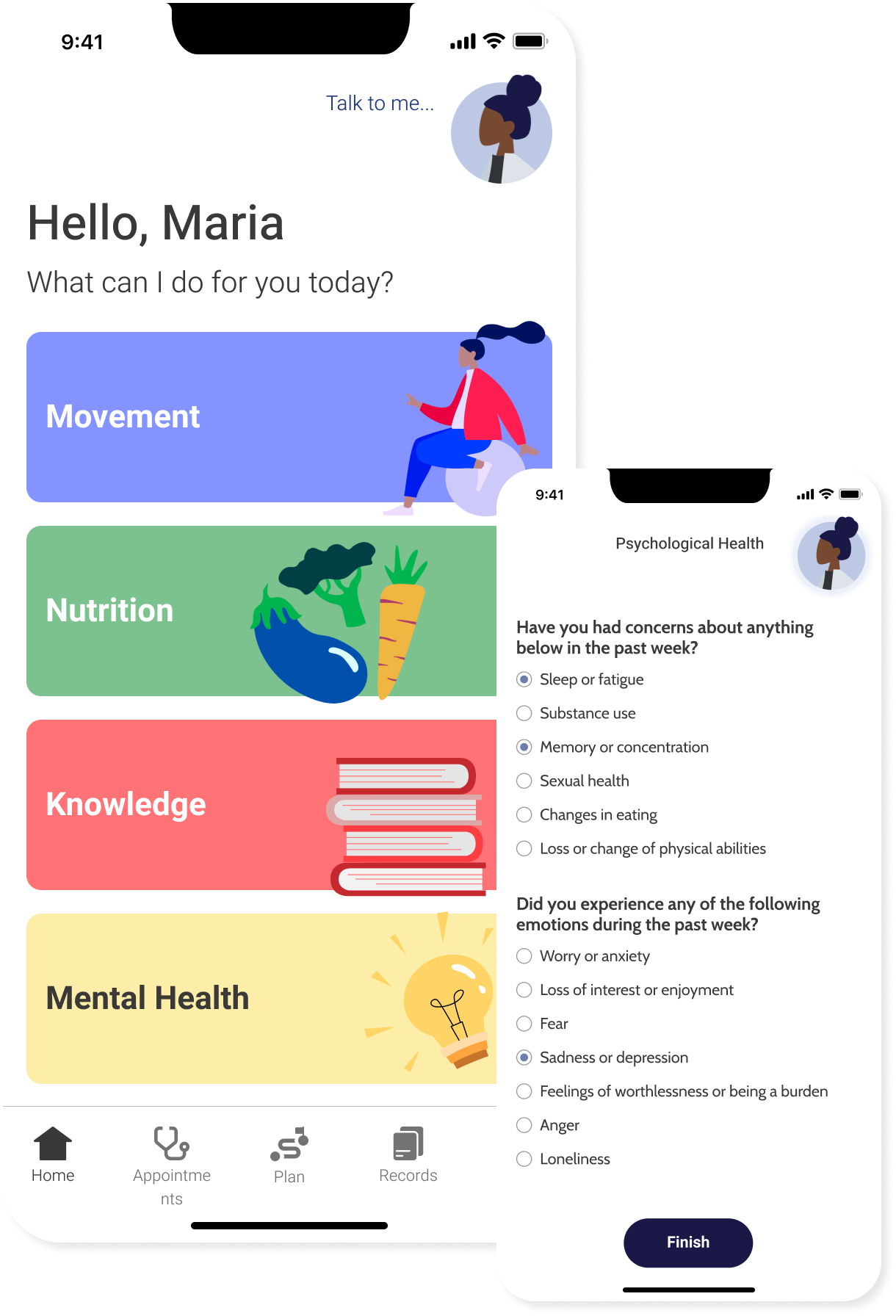
A fully personalized approach that improves your outcomes
No two cancer journeys are the same, which is why Asta creates a support program tailored to your unique needs. We have learned from thousands of cancer patients to deliver the best possible support experience and ensure that nothing is overlooked in your care.
Scalable Supportive Care for Oncology
Cancer care extends far beyond treating the disease itself. From diagnosis through survivorship, patients face complex challenges — pain, fatigue, anxiety, malnutrition, and uncertainty — that standard oncology workflows rarely address.
Sanexus bridges this gap by transforming evidence-based supportive care into accessible, scalable, and intelligent digital interventions. Built in collaboration with experts from learning cancer institutions, Sanexus enables oncology clinics to deliver comprehensive physical, psychological, and informational support that scales.
Our mission is to make expert-level supportive care available to every patient, regardless of geography or clinic resources, improving outcomes, enhancing quality of life, and advancing value-based oncology care.
ASTA
Asta delivers dynamic, personalized supportive care interventions for people with cancer. By combining behavioral science, clinical evidence, and AI for advanced care orchestration, Asta continuously adapts to each patient’s evolving needs — providing context-aware guidance that strengthens self-management, treatment readiness, and emotional resilience.

Aligned with National Comprehensive Cancer Network (NCCN) and National Cancer Institute (NCI) recommendations for patient-centered communication
Deliver continuous, adaptive, whole-person support from diagnosis through survivorship
Reduce complications and improve adherence through proactive monitoring and timely interventions
Enhance patient satisfaction, trust, and engagement
Advance value-based care by reducing avoidable costs and improving quality metrics

Asta integrates patient-reported outcomes (PROs) and electronic health records (EHR) to identify risks early and deliver precise interventions across psychological support, nutrition, physical activity, and informational care. It automates assessments, daily check-ins, and progress monitoring, allowing clinics to deliver high-quality supportive care without additional staff burden.
The system is grounded in validated behavioral and psychological frameworks — promoting self-efficacy, continuity of care, and measurable improvement in patient outcomes. Each interaction is guided by principles of therapeutic alliance, emotional attunement, and empowerment, ensuring patients feel supported throughout their cancer journey.
-

Assess
Collects patient-reported outcomes (PROs) and key clinical data from the electronic health record (EHR) to establish a holistic baseline of each patient’s physical, psychological, and social needs.
-

Identify
Uses AI-driven risk stratification to detect early signs of distress, malnutrition, low activity, or other barriers to treatment adherence. The system continuously analyzes behavioral, emotional, and clinical indicators to prioritize patients who need the most support.
-

Intervene
Delivers personalized, evidence-based interventions across nutrition, psychological support, and physical activity — dynamically adapting to patient progress and feedback.
-

Monitor
Tracks engagement, recovery, and outcomes over time, alerting clinicians when escalation or follow-up is warranted.
-

Malwina Lewicka, PhD
Co-Founder & CEO
Malwina Lewicka, PhD, is a health psychologist and behavioral scientist committed to improving how people facing cancer experience their care. She earned her PhD in Health Psychology from Brook University and completed a postdoctoral fellowship in Psycho-Oncology at Memorial Sloan Kettering Cancer Center, where she studied how individuals adapt psychologically to a cancer diagnosis and treatment, and how to ease the psychological and physical burdens of cancer.
Having seen firsthand how difficult it can be for patients to access the right support when they need it most, she received venture funding from the Jacobs Institute at Cornell Tech and co-founded Sanexus—an AI-driven platform designed to make supportive care instantly accessible, more connected, compassionate, and effective for both patients and clinicians.
-

Michael Federico
Co-Founder & CTO
Michael Federico is an engineer who builds software systems designed to improve the way we live and work. His work in conversational AI applications has been used in some of the largest financial institutions. He believes that today’s technology holds enormous improvements for patients with cancer and other chronic diseases.
Michael holds a BS in Computer Science from the University of Notre Dame.